Soft Dramatic Wedding Guest Gown Decisions
A Soft Dramatic wedding guest plan for an R&M Richards wrap maxi with a draped waist and rhinestone embellished sleeves.
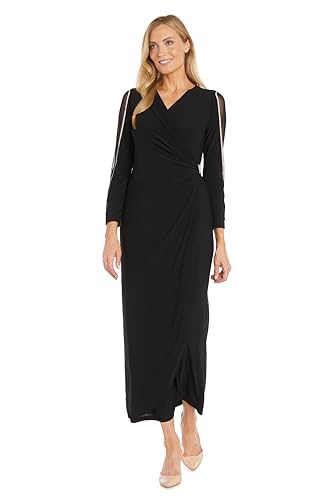
The R&M Richards wrap maxi already gives a Soft Dramatic wedding guest the main ingredients of a strong formal look: length, waist emphasis, drape, and concentrated sparkle at the sleeves. The smartest styling choice is restraint. Keep the gown as the visual center, let the sleeve embellishment provide the jewelry effect, and use shoes and a layer to extend one uninterrupted line.
That approach matters because every addition changes the balance. A delicate extra detail can disappear beside the rhinestones, while another large sparkling piece can make the upper half feel crowded. The goal is not to add drama everywhere. It is to decide where the drama belongs.
Read the gown before adding accessories
Start with the gown's fixed features. It is an evening maxi with a faux wrap impression, a draped waist, and long rhinestone embellished sleeves. Those features create three visual zones: the neckline, the waist, and the sleeve line. Treat them as a connected composition instead of separate places to decorate.
A comparable R&M Richards style at Macy's uses a surplice neckline, statement sleeves, and a rhinestone accent at the side waist. That combination supports a useful rule for this gown: repeat the direction of the wrap and drape, but do not repeat every sparkling detail.
Before choosing accessories, put the gown, intended shoes, and possible layer in one view. Ask whether your eye travels smoothly from shoulder to hem. If it stops at a contrasting shoe, a short boxy jacket, or a busy necklace, simplify that point first.
Choose one focal sparkle zone
The sleeves are already the focal sparkle zone, so jewelry should frame them rather than compete. Choose earrings with a clear shape and enough presence to register at formal scale. Keep the necklace minimal or skip it if the neckline and sleeve detail already create a complete upper frame.
Use one of these accessory paths:
- Choose sculptural earrings and no necklace when the sleeves look brightest near the face.
- Choose a simple pendant only when the neckline feels visually empty in the full outfit.
- Carry a smooth clutch with little hardware so the hand area stays calm beside the embellished sleeves.
- Repeat one metal tone across earrings, clutch hardware, and shoes without matching every detail exactly.
This is a hierarchy decision, not a ban on jewelry. Soft Dramatic styling can support scale and shine, but the effect is clearest when one element leads and the others reinforce it.
Keep shoes and layers in one long line
For shoes, prioritize continuity with the gown's color depth and formality. A streamlined pump, sandal, or pointed flat can work when its straps and hardware do not introduce a second busy pattern. A close tonal relationship usually keeps the hemline moving, while a sharp contrast makes the shoe a separate focal point.
For a layer, look for length, drape, and a clean opening. A long coat, fluid wrap, or evening layer that falls vertically is easier to integrate than a stiff cropped jacket. The layer should reveal the waist treatment when open and avoid crushing or hiding the embellished sleeves.
The same principle appears in this guide to preserving a sweeping Soft Dramatic line: accessories work best when they support the dress's main direction. Here, the added wedding constraint is that the outfit must also feel polished from arrival through the reception.
Consider the practical sequence of the event. If the ceremony is cool but the reception is warm, choose a removable layer that looks intentional both carried and worn. If the venue requires walking on grass or stone, select a stable shoe shape without sacrificing the long visual line.
Run the final wedding guest check
Step back and review the whole outfit in ordinary lighting, not only a close mirror. The rhinestones should read as a controlled highlight, the waist drape should remain visible, and the shoes should finish the line rather than interrupt it. Check that the layer can move over the sleeves without snagging or bunching.
Then remove one optional item and compare. If the outfit becomes clearer, leave that item out. If it loses needed scale, restore it and simplify somewhere else. This edit is especially useful with a gown that already combines wrap direction, waist emphasis, length, and embellishment.
The finished look should have a simple order: gown first, face second, accessories third. That order preserves the Soft Dramatic impact while keeping the wedding guest outfit considerate and adaptable. You are not trying to make every piece memorable on its own. You are building one formal line in which the rhinestone sleeves have a clear reason to lead.