Lantern or Wide Leg Pants for Natural Outfits
Lantern and straight wide leg trousers distribute relaxed volume differently. Use the featured gray IXIMO pair to choose a rounded outline or a continuous fall, then connect your top and shoes.
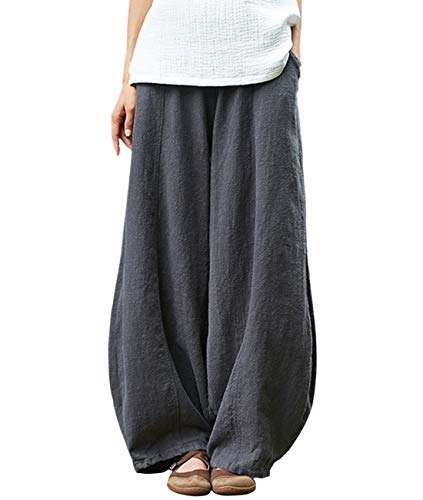
Choose lantern pants when you want a relaxed outfit with a visible rounded shape that narrows again near the shoes. Choose a straighter wide leg when you want the lower half to read as a continuous fall of fabric. For someone using Natural lines as a styling guide, the decision is about the amount and placement of volume, rather than a rule that one trouser shape belongs to one body.
The featured IXIMO trousers are the Gray pair in Large. Their photograph shows roomy legs with an inward turn near the hem. Use that shape as the starting point for this comparison, then decide whether you want the trousers to be the main shape in the outfit or a quieter background. The photo cannot tell you how the fabric will hang on you.
Compare the outline before the size
A wide leg and a lantern leg can both offer room, but they distribute it differently. A straighter wide leg carries its width down toward the floor. A lantern outline grows fuller through the leg and returns inward at the bottom. Look at the outline from the knee to the shoe: does it continue outward, fall almost straight, or curve back in?
That distinction matters more than the word baggy. If you want a broad, quiet lower half beneath an open shirt, a continuous wide leg may be the easier visual partner. If you want an intentional rounded shape beneath a simple top, the lantern outline provides that focal point. Neither choice requires hiding your waist or making your legs appear smaller.
Stylist Angie Cox explains in her lantern pants guide that narrowing at the hem gives a wide leg some structure. Her examples also show different degrees of drape above the trousers. That is useful general styling guidance; it does not establish how this pair fits or prescribe a Kibbe category.
For a Natural interpretation, start with relaxed room through the shoulders and a lower shape you can still read clearly. You can keep the upper half soft without matching every bit of trouser fullness with equal fullness above. Think of the pants as one deliberate shape within the whole outfit, rather than a reason to add more volume everywhere.
Decide where the outfit gets its shape
The first decision is whether the rounded leg should stand out. A relatively simple tee makes the trouser outline easier to see. An open shirt adds a second frame around it. A long, full top can create one larger volume from shoulder to hem. Choose the effect you want before deciding that the pants need a more fitted top.
For an easy starting point, pair the gray trousers with a softly shaped white tee whose hem ends above the fullest part of the leg. This creates a visible boundary between the two garments without requiring a tight waist. A small front tuck is another option if the waistband and fabric cooperate, but it is optional. Leave the top loose if tucking produces a knot of fabric.
Use these choices to keep the comparison concrete:
- Choose the lantern outline with a simple top when you want the rounded leg to be the main shape.
- Choose a straight wide leg with an open shirt when you prefer a more continuous lower line.
- Keep a loose top with lantern pants when a broader, more architectural outfit is the intended result.
The gray pair can also sit beneath a muted knit and an open jacket. Keep the jacket edge visible so the layers read separately. If the jacket is as full as the pants and the outline loses all definition, change one garment first. Switching to a simpler top or a straighter trouser is a clear choice, rather than adding a belt and more accessories to solve several competing shapes.
For more detail on the upper garment, our Natural tee guide compares loose, partial tuck, and full tuck options. Use it after choosing the leg outline; a tuck should support the overall shape you want, rather than make the silhouette decision for you.
Let the hem meet the shoe deliberately
A narrowed hem places attention near the shoe in a different way from a wide hem that falls around it. With the featured pair, the photograph shows the fabric gathering visually near flat tan shoes. That is a styling example, not a promised trouser length. The hem position will depend on your height, proportions, and the actual garment.
Start with footwear you already wear and check whether the hem sits clear of the floor. A simple flat or sandal lets the inward curve remain visible. A substantial shoe adds another shape at the bottom, which may be exactly what you want. If the fabric covers most of the shoe and the lower outline becomes a pile, resolve the length before choosing additional details.
Use the same top and shoes when comparing trouser shapes. The straight wide leg may create a continuous line over the shoe; the lantern leg may frame it more closely. Pick the effect you prefer in the entire outfit. You do not need to buy another pair of shoes to justify a trouser shape that otherwise feels wrong for your wardrobe.
Check the gray pair before buying
The merchant lists an elastic closure and a blend of 80% linen and 20% cotton. Those are listing claims, rather than independent fabric testing. The photograph cannot establish opacity, stretch, or how much the garment will soften or shrink. Check the current measurements for Large and compare them with a pair that already fits you; a familiar size letter is not a measurement.
The listing also gives conflicting washing advice: its care field says hand washing only, while another section mentions a gentle machine cycle. Do not choose the more convenient instruction by assumption. Follow the care label on the delivered garment, and ask the merchant to clarify before purchase if machine washing is essential to you.
Before committing, check the current Gray and Large selection, the measurements, the return terms, and the available offer. Price and availability may change. Choose this pair for its rounded outline only if you want that visible shape; choose a straighter wide leg if you prefer an uninterrupted lower line. That is the useful distinction to carry into your next outfit, whichever trousers you select.