Is This Lotusmile Blouse Too Busy for Soft Classic?
The Lotusmile blouse combines ruffled bell sleeves with a flowy layered A-line hem. Here is how Soft Classic can judge the total effect and build a calmer outfit.
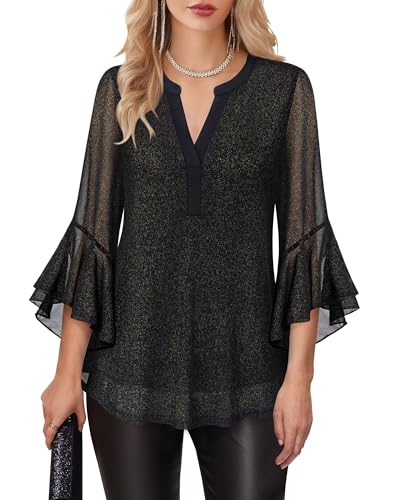
No, the Lotusmile double layered blouse is not automatically too busy for Soft Classic. Its open V-neck can provide clarity, while the ruffled bell sleeves, flowy layered hem, and patterned textured mesh create several softer details that need room. The useful test is not whether each feature is delicate on its own. It is whether the neckline, sleeves, hem, pattern, and rest of the outfit form one balanced composition.
Detailed Does Not Automatically Mean Too Busy
The common myth is that Soft Classic must avoid every blouse with visible detail. That rule is too blunt. Detail can work when it has an order. On this blouse, the V-neck creates a clear central opening, the sleeves add movement near the arms, and the layered hem adds movement lower down. The pattern and mesh then spread interest across the surface.
Instead of counting details, decide which one you notice first. If your eye lands on the face and neckline, then moves gently through the sleeves and hem, the composition may feel coherent. If the print, sleeve ruffles, hem, jewelry, belt, and trousers all demand attention at once, the outfit has lost its hierarchy. The answer is to quiet the supporting pieces, not to assume the blouse itself is forbidden.
This is a different problem from learning to balance a Soft Classic tweed blazer. A blazer asks you to negotiate structure at the shoulders, waist shaping, buttons, and firm texture. This blouse asks you to organize softer movement and surface detail without letting the outline drift.
Read the Blouse as One Composition
Start at the V-neck. It gives the blouse a simple opening that can keep the upper body from looking closed in. Preserve that clarity with a modest pendant or no necklace. A broad statement necklace would create a second focal point in the same small area, which can make the patterned mesh feel busier.
Next, look at the three quarter bell sleeves with ruffles. Their volume is already expressive, so they do not need a stack of bracelets or a highly detailed cuff beside them. Let the sleeves carry the movement. A simple watch, small earrings, or bare wrists can give that movement a cleaner boundary.
Then consider the double layered flowy hem and A-line silhouette. Both add expansion below the torso. The question is whether the hem settles into a readable shape over the lower half. If the blouse and bottoms both flare strongly, the total outline may become diffuse. If the lower half is calm and lightly shaped, the hem can remain the softer finishing line.
Finally, step back and assess the patterned textured mesh with every other element visible. Pattern is not a separate issue from shape. It amplifies whatever the sleeves and hem are already doing. In a quieter colorway or against a low contrast base, that surface detail may read as gentle texture. With a loud lower half and bold accessories, it can become one signal too many.
Calm the Supporting Pieces
Use the lower half to give the blouse an anchor. Straight trousers, a gently tapered trouser, or a simple skirt can provide a clean field beneath the flowy hem. The goal is not stiffness. It is a lower outline that does not repeat the blouse's volume. Keep the waistband visually simple so the layered hem does not compete with a large buckle, paper bag waist, or dense pleating.
Color can do as much work as shape. Pull one quiet tone from the blouse into the bottoms or shoes, then repeat it sparingly. This reduces visual jumps across the outfit. A close color relationship also lets the mesh and ruffles read as part of one blouse rather than as several disconnected effects.
Accessories should finish the composition rather than restart it. Choose a bag with a clean outline and shoes with a refined shape. If you want jewelry, place emphasis near either the face or wrist, not both. This restraint gives the blouse enough space to be decorative while keeping the whole look polished.
Before keeping the blouse, check the practical facts too. The outer material is listed as 95% nylon and 5% spandex, while the inner layer is 100% polyester. The care guidance calls for a cold wash. Those details do not determine Soft Classic harmony, but they can determine whether the garment belongs in your actual routine.
Make It Work for the Office
The office context does not require erasing the blouse's personality. The Texas A&M Career Center professional attire guide calls blouse combinations business casual attire choices. Your workplace may set a different standard, but the category itself can fit a professional wardrobe.
For a more conservative office, let the blouse be the only visibly decorative garment. Pair it with solid trousers, a compact bag, restrained jewelry, and a simple shoe. If your office is more creative, you can echo one color from the pattern in an accessory, but keep the accessory shape clean. In either setting, the blouse should still be the product you are styling, not a background for several louder choices.
Do a final mirror check from a few steps away. Notice whether your eye can move from face to neckline, through the sleeves, and down to a calm lower half. If one area interrupts that path, remove or simplify the nearest supporting detail. That troubleshooting step is more useful than declaring the blouse too busy on sight.
The blouse works best for Soft Classic when its details share one hierarchy: clear neckline first, controlled sleeve movement second, softly expanding hem third, and quiet support everywhere else. You do not have to remove every decorative element. You only have to make the full outfit feel intentional.