How to Quiet a Ruffled Romantic Blouse
This white LYANER blouse can support Romantic lines when you quiet three competing signals: the collar area, the vertical button and ruffle line, and the transition into the lower half.
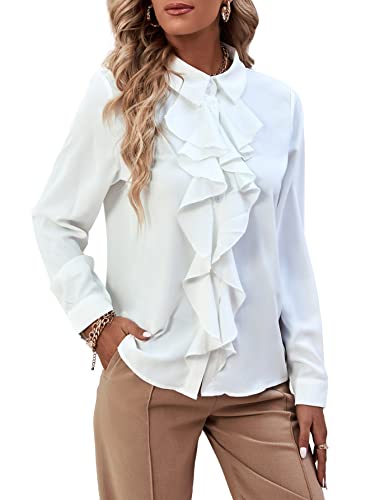
The white LYANER blouse can suit someone using Romantic lines when its collar, front ruffles, and button row do not all compete for attention. The listing identifies a collar neck, long sleeves, a button down closure, front ruffles, and a loose fit. Keep the ruffles as the curved focal point, then make three edits: clear the collar area, simplify the vertical front line, and continue the white blouse into a quieter lower half.
Diagnose the three competing signals
This blouse concentrates detail near the face and down the center. The collar creates a firm frame. The ruffles add curved volume along the front. The buttons create a repeated vertical rhythm. None of those details is automatically wrong for Romantic styling, but all three can become hard to read when jewelry, hair, a belt, or a patterned bottom introduces more signals nearby.
Start by looking at the blouse with no accessories. Ask where your eye lands first. If the collar and ruffles merge into one crowded area, the neckline needs space. If the button row appears broken by a necklace, belt, or waistband, the center line needs clarity. If the blouse seems to stop abruptly at the hips, the lower half needs continuity.
Solve only the signal that is causing trouble. The aim is not to remove every decorative element. It is to let one curved feature lead while the rest of the outfit supports it. For broader outfit ideas after this diagnostic pass, use our general Romantic ruffle styling guide.
Quiet the collar area
Treat the collar and front ruffles as one shared detail zone. Begin without a necklace. The ruffles already bring movement close to the neckline, so empty space can make them easier to see. If the area still feels closed, change what surrounds the collar before adding jewelry. Pull hair away from one side, choose a simple earring, or leave the top button open only if the blouse sits securely and the result looks intentional.
If you want jewelry, use one small curved accent that does not cross the ruffle edge. A short pendant can create another vertical line and may interfere with the buttons. A compact earring keeps the center clear. Check the full outfit from a few steps away because a detail that looks separate in a close mirror can merge with the ruffles at normal viewing distance.
Color matters here too. Keep nearby accessories close to the blouse, your skin, or one repeated outfit color. Strong contrast at the ear, neck, and collar can create three separate stopping points. One restrained accent gives the blouse room to remain the main source of softness.
Clarify the button and ruffle line
The front of this blouse already has a clear route from collar to hem. Protect that route by limiting interruptions. Avoid a long necklace that crosses the buttons, a scarf that rests over the ruffles, or several pins along the center. Those additions do not merely add detail. They divide the vertical line into competing pieces.
Look at the ruffles and buttons together rather than treating them as separate decorations. If the ruffles lead, let the buttons act as quiet structure. Repeat rounded shapes in only one other place, such as an earring or shoe detail, instead of echoing ruffles throughout the outfit. An independent ruffle styling guide balances ornate ruffles with simpler bottoms, which is useful here because it leaves the center of the blouse readable.
Tucking can also change this line. A full tuck creates a firm stop at the waistband, while leaving the blouse loose lets the center continue farther downward. Try both with the same bottom. Choose the version that keeps the buttons and ruffles visually connected without bunching the loose fit into a dense cluster.
Continue into a quieter lower half
Use the lower half to absorb the blouse rather than compete with it. High waisted trousers or an A-line skirt can provide a simple shape beneath front ruffles. Choose a calm surface and avoid placing a bold print, several buttons, or a highly contrasting belt directly below the blouse. A simpler bottom does more than look plain. It gives the eye somewhere to rest after the concentrated front detail.
For continuity, repeat the white once or keep the value change gentle. A pale shoe, a light bag, or a bottom in a nearby light value can carry the blouse color beyond the hem. If you prefer a dark bottom, use a clean waistband and repeat the dark color at the shoe so the lower half reads as one unit rather than several horizontal bands.
Before buying, confirm the exact variant and material. The listing identifies the white option in size X Large and 100 percent polyester. Those facts do not predict how the blouse will fit or feel on you. Check the current retailer details, compare the listed measurements with a blouse you own, and decide whether the loose cut works with the bottoms you intend to wear.
Finish with one check of all three signals. First, can you see space around the collar? Second, do the ruffles and buttons read as one front direction? Third, does the lower half continue the outfit without another crowded boundary? If one answer is no, change only that zone and look again. This keeps the Romantic softness while making the exact blouse easier to judge and style.