Can Large Cat Eye Sunglasses Work for Gamine?
Wide leopard cat eye sunglasses can work for Gamine when they become the outfit's one concentrated statement. Use scale, color, and fit checks before buying.
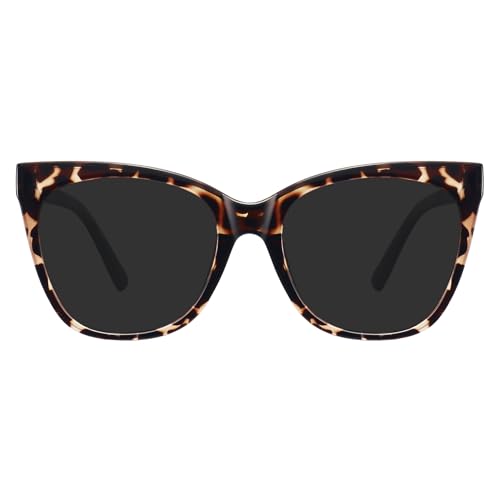
Large cat eye sunglasses can work in a Gamine outfit when their width is treated as one deliberate burst of contrast, not permission to make every element louder. This WOWSUN pair has a 147 mm frame, tall grey lenses, and a leopard pattern, so it needs a compact outfit with clear stops around it. If you already wear wide frames comfortably and can keep the rest of the look edited, the scale can feel witty and intentional. If the frame hides your expression or forces the temples outward, choose a smaller shape instead.
Give the frame one clear job
The upswept outer corners provide a crisp directional edge, while the rounded lower lens and leopard pattern keep the effect from becoming severe. That combination is useful for Gamine styling because it mixes sharpness with play. The catch is scale: at 147 mm across, the frame reads as a statement before any jewelry, collar, or print enters the picture.
Use a simple decision rule before building the outfit:
- Keep the cat eye as the only large detail near the face.
- Repeat one frame color in a small accessory, not in another full print.
- Add one visible clothing break through a crop, tuck, short jacket, or contrasting waistband.
- Remove an element if the sunglasses, neckline, earrings, and hair accessory all demand equal attention.
This is not a rule that Gamine accessories must always be small. It is a way to make a large accessory feel precise. The frame supplies the surprise; the clothing supplies the boundaries.
Use leopard as punctuation
The selected frame pairs a leopard pattern with grey lenses. Treat that print like punctuation rather than a theme. A camel belt, warm brown shoe, or small tortoiseshell clip can echo one tone without turning the outfit into a matching set. Black and white clothing can make the pattern especially clear, but navy, red, or leaf green can also work when the shapes remain compact.
Avoid placing a busy scarf, ornate earrings, and a patterned collar beside the frame. Pick one companion detail instead. Small gold studs can repeat the warmth. A crisp red lip can answer the frame's energy without adding another object. A plain collar can give the upswept edge room to register.
The same editing applies to makeup and hair. The sunglasses already create a strong upper face boundary. A clean part, short fringe, ponytail, or controlled wave keeps that boundary visible. This is about visual placement, not prescribing a haircut or feature shape.
Build compact rhythm below the frame
A wide frame becomes easier to carry when the outfit below it does not dissolve into one long, vague column. Use two or three concise sections: a fitted tee with cropped trousers, a short jacket over a column of color, or a tucked blouse with a visible waistband. Each break gives the eye somewhere to land after the sunglasses.
For a casual formula, try a white fitted tee, dark ankle length jeans, and a camel belt. The tee and jeans stay quiet while the belt picks up a warm note from the leopard frame. For a sharper formula, use a cropped black jacket, ivory shell, and straight red skirt. The jacket edge and skirt color create two clean beats without competing near the face.
Volume can still appear, but give it a boundary. A full skirt works better here with a defined waist and simple top than with a long loose layer. Wide trousers can work with a close top and short hem. The goal is not tightness; it is a readable sequence of shapes.
Current runway reporting places both oversized silhouettes and modern cat eyes among 2026 eyewear directions. Trend relevance may make the frame easier to find, but it does not settle the fit or outfit decision. The useful question remains whether this exact width creates one controlled contrast on you.
Compare the measurements before buying
The product page lists a 147 mm overall frame length, 50 mm lens width, 55 mm lens height, and 133 mm temples. Those numbers matter more than the word “large.” A frame sizing guide recommends using eye size, bridge width, and temple length, and comparing the full width with a pair that already fits.
Place a comfortable pair on a flat surface and measure across the front from endpoint to endpoint. Compare that number with 147 mm. Then compare the lens width and temple length printed inside the arm. A few millimeters can change where the frame sits and whether the arms angle outward.
The listing presents inconsistent bridge measurements in different sections, so do not rely on one bridge number for this purchase. The safest online check is to compare the full width, lens width, and temple length that are consistently stated, then use the return policy if the frame slides, pinches, or sits unevenly. Polarization and the listed UV400 claim are useful lens features, but they do not correct a poor physical fit.
Choose this pair if you want leopard pattern, a pronounced cat eye edge, and a deliberately wide statement that can anchor otherwise compact outfits. Skip it if your best fitting frames are much narrower, if you prefer several near face accessories at once, or if the pattern would be difficult to connect to your wardrobe. If width is the obstacle rather than the shape, compare smaller round polarized frames as a quieter alternative.