The One Cuff Rule for Dramatic Classic Outfits
A practical one cuff rule for balancing the FUTIMELY cross wire bracelet with tailored Dramatic Classic lines.
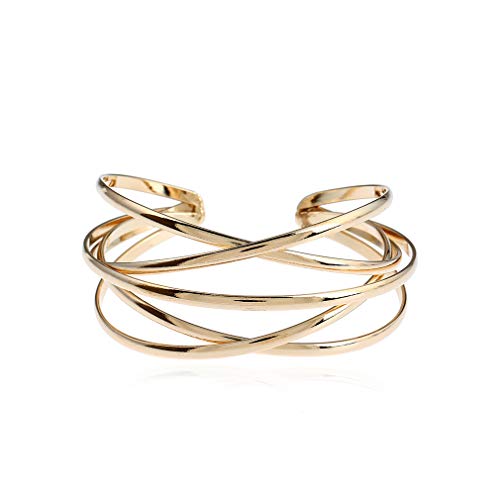
The FUTIMELY cross wire cuff can work in a Dramatic Classic outfit when it is treated as the one deliberate focal point, not the start of a bracelet stack. Its open shape, crossing lines, and metallic finish already provide enough visual activity. Keep the sleeve boundary clean, repeat the metal once elsewhere, and let the rest of the outfit return to controlled tailoring.
Use one cuff as the focal point
The exact bracelet is listed as an open adjustable cuff made from alloy, with several metallic finish choices. Its multiple crossing wires create a broad, graphic shape even though the spaces between them keep the wrist visible. That combination is useful for Dramatic Classic styling because it offers a strong accent without requiring several separate bracelets.
A broad cuff attracts attention by design. The independent cuff styling guide recommends letting a statement cuff work alone and pairing it with simpler clothing. Translate that advice into one clear rule: if this cuff is on your wrist, skip another wide bracelet, a competing watch, and a large ring on the same hand. The point is not minimalism for its own sake. It is visual hierarchy.
Look at the complete outfit from several steps away. Your eye should register the tailored silhouette first, then the cuff as a crisp accent. If the wrist becomes the whole story, remove a competing accessory before changing the jacket, dress, or trousers. That preserves the stronger Dramatic Classic line while keeping the bracelet purposeful.
Choose a clean sleeve boundary
The easiest placement is against bare skin with a sleeveless shell, a short sleeve, or a sleeve that ends clearly above the cuff. This gives the crossing wires their own space and prevents a soft or gathered fabric edge from blurring the outline. A smooth long sleeve can also work when it stays close to the arm.
Who What Wear shows statement cuffs worn over crisp shirt sleeves and sleek knits. For this exact cuff, use that idea only when the sleeve is smooth and fitted enough to form a clean base. Place the bracelet where the fabric does not bunch. Then check that the open crossing pattern remains readable rather than sinking into folds.
Avoid making the cuff compete with a flared sleeve, a deep stack of shirt cuffs, or a cluster of buttons at the wrist. Those details create several boundaries at once. If the outfit needs a fuller sleeve, move the visual emphasis elsewhere and save the bracelet for a cleaner arm line.
Repeat the metal only once
Choose the cuff finish by looking at the hardware already in the outfit. Gold can echo one small bag clasp or a simple earring. Silver can repeat a belt buckle or a structured shoe detail. The goal is one quiet connection, not an exact set of matching jewelry.
Keep the repeated element smaller than the cuff. A compact stud, a narrow buckle, or one visible button can make the bracelet feel integrated without creating another focal point. If the blazer already has prominent gold buttons, the gold finish may be enough repetition by itself. There is no need to add a large necklace as proof that the metals coordinate.
Color contrast matters too. A metallic cuff is most legible beside a solid sleeve or a restrained palette. Black, white, navy, charcoal, and other controlled combinations give the crossing wires a clear background. A busy print can still work, but only when its scale stays secondary and the rest of the jewelry remains quiet.
Run a final buying check
Before buying, compare the cuff shape with a bracelet you already own. The listing describes an adjustable open form, but adjustability does not answer every scale or movement question. Use the product image to judge the width of the crossing pattern, then measure a similar visual area on your wrist. This is a scale comparison, not a promise about fit.
Use four checks before deciding:
- The cuff will be the only wide wrist accessory.
- At least one common sleeve creates a clean boundary.
- One smaller outfit detail can repeat the metal.
- The open crossing pattern stays visible from several steps away.
If all four checks pass, the cuff has a defined job in the wardrobe. It gives a tailored Dramatic Classic outfit one controlled piece of jewelry with enough edge to feel intentional. If one check fails, identify the actual conflict. You may need a cleaner sleeve, fewer accessories, or a quieter print rather than a different bracelet. That is the useful decision: protect the outfit structure first, then let the cuff sharpen it.